Cricket Spikes or Rubbers? How to Pick by Surface in South Africa
Metal bites into turf. Rubbers grip astro without wrecking it. Why most SA club players carry both.
Metal spikes bite into turf. Rubbers grip astro without tearing it up. That single distinction decides whether you need cricket spikes or rubbers, and it is the reason most South African club players end up owning both pairs rather than one.
Walk into any pro shop and the wall of cricket shoes looks like a colour choice. It isn’t. Two shoes that look near enough identical, same brand, same model name, can have completely different soles, and picking the wrong one means either a wrecked practice surface or a season of sliding around at the crease.
What is the difference between cricket spikes and rubbers?
Spikes have metal studs that screw into the sole and sink into soft grass, while rubbers have a moulded rubber sole with small pimples and no metal at all. That is the whole difference. On most models the upper is the same shoe.
Take the adidas 22YDS range we stock. There is a spike version and a nets rubber version. Same silhouette, same materials up top. The sole is the decision.
Metal studs work by penetrating the surface. On a well-watered turf wicket at Wanderers or Centurion in October, the ground is soft enough for a stud to sink in and give you something to push against. That is grip you cannot get any other way. Rubbers work by friction instead, gripping the surface rather than digging into it, which is what you want when the surface is a synthetic mat over concrete.
Can I wear metal spikes on artificial turf or astro nets?
No. Metal studs tear synthetic matting, and the concrete base underneath gives them nothing to sink into, so you slide instead of gripping. Most clubs will turn you away at the net gate for it.
This matters more in South Africa than a lot of overseas advice suggests, because of how our week is structured. Saturday league cricket is on turf. Midweek practice, at most schools and clubs, is in astro nets. Same player, same week, two surfaces with opposite requirements.
Groundsmen are not being precious about it either. Synthetic surface manufacturers are explicit that metal spikes will rip a synthetic cricket surface, and on a concrete-based installation they create a slip hazard on top of the damage. A set of nets costs a club a great deal of money and one player in spikes can do visible damage in a single session.
So if your club runs astro nets, rubbers are not optional. They are the entry requirement.
Do I actually need both spikes and rubbers?
Most South African club and school players do, because turf on Saturday and astro midweek is the standard rhythm of a season here. One pair does not cover both properly.
Here’s the thing though. If the budget only stretches to one pair right now, buy rubbers. Rubbers are legal and safe on every surface, including turf. You give up some grip on a soft wicket, and a quick bowler will feel that in the delivery stride, but you can play. Spikes on astro is the reverse problem: you simply cannot use them. One pair covers everything at reduced performance, the other covers half your season at full performance.
Once you know which surface you play on most, you can narrow our cricket shoes down to the right sole before you start comparing brands.
What cricket shoes do bowlers need?
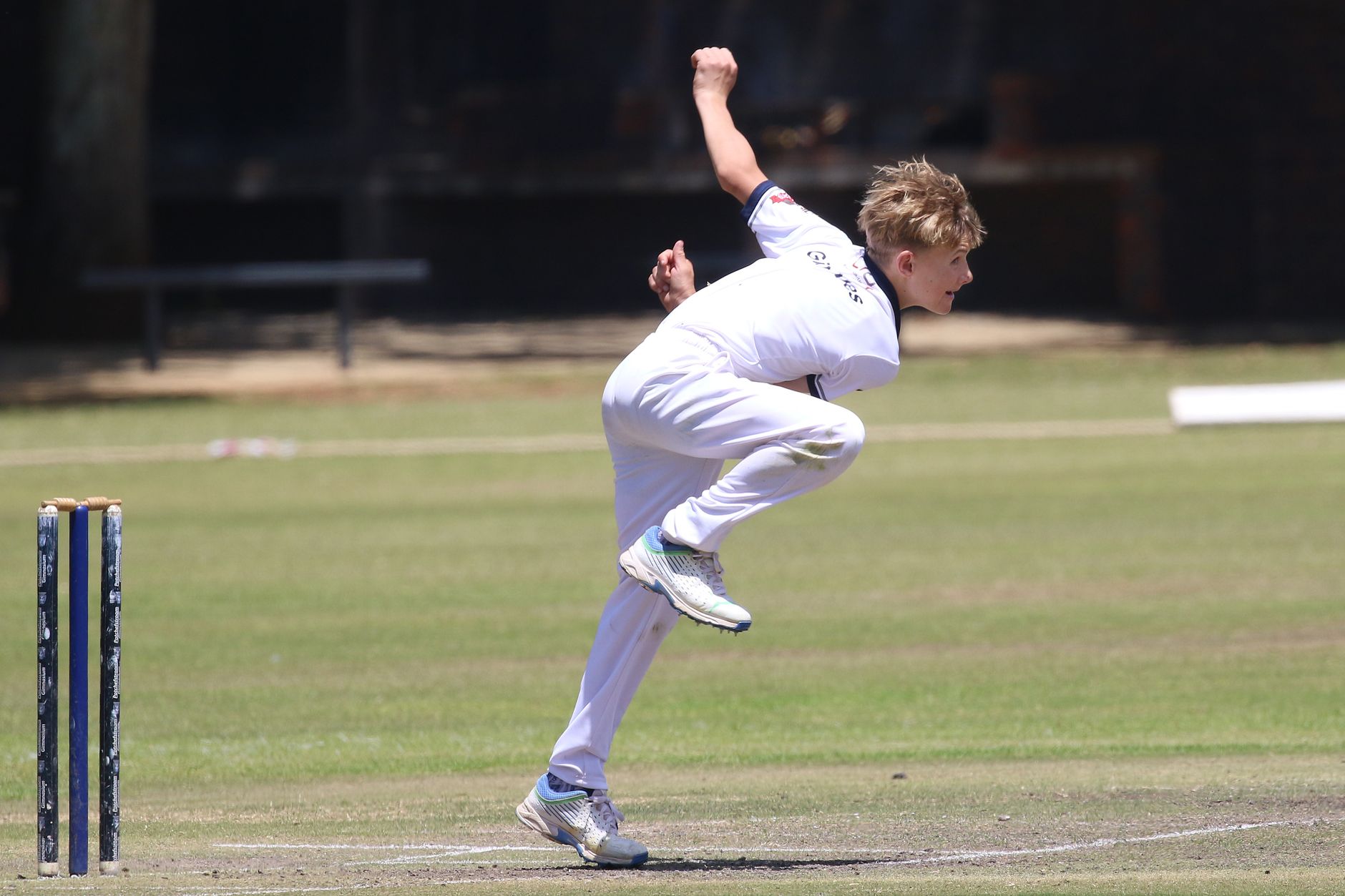
Fast bowlers need full spikes with a reinforced toe and a stiff midsole, because the front foot lands under several times bodyweight in the delivery stride and a soft sole simply folds under it. This is the one position where footwear choice is not really a preference.
A bowler’s front foot slams down, the whole body rotates over it, and the back toe often drags along the ground behind. That drag is why bowling-specific shoes get a reinforced toe cap. Without one, you wear a hole through the front of an ordinary shoe within a season. The New Balance CK4040 and the adidas Adipower are both built for this, and a mid-cut version adds ankle support for anyone who has rolled one before.
Batsmen and spinners have an easier decision. Lighter shoes, often half spikes with studs only under the forefoot, because you are moving in short bursts and turning rather than landing under load. Wicket-keepers generally want the lightest option they can get away with, since you spend the day in a squat.
Are cricket spikes replaceable?
On most spiked models the studs screw out with a small spanner, so worn spikes get replaced rather than the whole shoe. This is worth knowing before you write off a pair that still has plenty of upper left in it.
The metal wears down long before the shoe does. A club player will usually flatten a set of studs in a season while the shoe itself is barely broken in. Replacing the studs is a fraction of the cost of replacing the pair, and it takes about five minutes on the kitchen table.
We keep replacement metal spike sets and soft stud sets from GM and Gray-Nicolls on the shelf. One caution: threads are not universal across brands. Bring the shoe, or at least one of the old studs, so we can match it rather than guessing. And replace a worn stud before it rounds off completely, because a stripped socket is a much bigger problem than a flat spike.
How to choose cricket shoes in South Africa, by surface
Match the sole to the surface you play on most, then buy the second pair for the other surface when you can. The short version:
- Turf wickets and grass outfields: metal spikes. Full spikes for bowlers, half spikes are fine for batting.
- Astro nets and synthetic wickets: rubbers only. Metal is usually banned and always damaging.
- Indoor cricket: rubbers, and check whether the venue requires non-marking soles.
- Hard, dry, sun-baked ground in midsummer: rubbers are often the better choice even on natural turf, because baked ground is too hard for a stud to penetrate and you end up standing on the spikes rather than in the ground.
That last one catches people out in January and February. A wicket that took spikes beautifully in spring can be concrete-hard by midsummer, and if the studs cannot sink in you get less grip than rubbers would give you, not more.
On sizing, go up roughly half a size from your everyday shoe. Cricket socks are thicker, and feet swell through a long bowling spell or an afternoon in the field in Highveld heat. Too tight is how you lose toenails.
Where to buy cricket spikes in South Africa
We carry spikes and rubbers across adidas, New Balance, GM, Gray-Nicolls and DSC in both senior and junior sizes, in all eight branches. You can see the current cricket spikes and nets rubbers ranges online before you come in. Junior spikes matter more than people assume, because a school player in adult shoes half a size too big is a rolled ankle waiting to happen.
Fitting cricket shoes properly is genuinely worth doing in person. Bring your match socks. We will check the length with you standing, because feet spread under load, and check that the heel is locked in properly, which is what stops blisters over a long day. If you are between two sizes, that ten minutes saves a return and a wasted Saturday.
Our staff play. Ask whoever is on the floor what they wear for their own club cricket and you will get an honest answer, including when the entry-level pair is the right call.
Common questions
What is the difference between cricket spikes and rubbers?
Spikes have metal studs that screw into the sole and bite into soft grass. Rubbers have a moulded rubber sole with small pimples or dimples and no metal at all. Spikes are for natural turf. Rubbers are for artificial surfaces, indoor courts and hard ground. The upper is often identical between the two versions of the same model, so the sole is the whole decision.
Can I wear metal spikes on artificial turf or astro nets?
No, and most clubs will stop you. Metal studs tear synthetic matting and the concrete base underneath gives them nothing to sink into, so you slide. It ruins the surface and it is a genuine ankle risk. Astro nets need rubbers. This is the single most common reason a player ends up buying a second pair.
Do I need both spikes and rubbers?
Most South African club and school players do, because Saturday matches are on turf and midweek nets are usually on astro. If you can only buy one pair to start, buy rubbers. They are safe on every surface including turf, whereas spikes are unusable on half of them.
Are cricket spikes removable?
On most spiked models yes. The studs screw out with a small spanner that usually comes in the box, so you can replace worn ones rather than the whole shoe. We stock replacement metal spike sets and soft stud sets from GM and Gray-Nicolls. Check the thread matches your shoe before buying.
What cricket shoes do bowlers need?
Fast bowlers need spikes with a reinforced toe and a stiffer midsole, because the front foot lands under enormous load in the delivery stride and a soft running-shoe sole folds. Full spikes rather than half spikes give the most grip through the crease. Spinners and batsmen can get away with lighter shoes and half spikes.
Can I wear running shoes to play cricket?
For indoor or a casual social game, yes. For anything on turf, no. Running shoes are built for forward motion only, so they roll when you push sideways off the crease or turn for a second run, and they have no toe reinforcement for bowling. It is the quickest way to a rolled ankle.
How long do cricket spikes last?
A club player getting one season out of a pair is normal, two if the studs are replaced partway. The metal studs wear down long before the upper does, which is why replaceable spikes matter. Check them at the start of each season. If a stud is worn flat or the thread is stripped, replace it before it rounds off in the socket.
What size cricket shoes should I buy?
Go up about half a size from your normal shoe. Cricket shoes are worn with thicker cricket socks, and feet swell over a long innings or a bowling spell in the sun. Too tight and you will lose toenails in the delivery stride. Bring your match socks when you come in and we will fit them properly.